Groundwater Insecurities in the Colorado River Basin

Groundwater is a vital source of water for a large part of the United States; it’s used for drinking and irrigation, keeps wells and springs filled, and generally contains fewer contaminants than surface water. Declines in groundwater levels are a growing problem in recent years, resulting in lakes and reservoir levels dropping, and less water flowing in streams and rivers. One such river is the … Continue reading Groundwater Insecurities in the Colorado River Basin

Assessing Heat Pump Usage Across Alaska

2023 is on track to be one of the hottest years across the globe. Warming occurs at double the global rate in Arctic regions, necessitating the need for viable decarbonization options that help move away from dependence on fossil fuels. This summer, one of the eScience Institute’s Data Science for Social Good (DSSG) teams at the University of Washington has been researching heat pumps for heating and … Continue reading Assessing Heat Pump Usage Across Alaska

Just Do It: Strategies for Projects

Materials Matter is a five-session series from the AIA Seattle chapter that delivers comprehensive, high-level knowledge and strategies for assessing and selecting healthy, sustainable materials. I had the opportunity to attend the first run of the newly-developed series with many of the local industry leaders who helped create the innovative course materials. AIA Seattle is currently hosting the series for a second time.

The series encompasses everything tied to building materials and how they impact our lives: human health, the tools and data available for assessing and prioritizing materials, and strategies for integrating informed decision-making into projects and practice. Join me as I discover exactly why Materials Matter.

AIA MM 4

Continue reading “Just Do It: Strategies for Projects”

Tools of the Trade: Assessment & Implementation

Materials Matter is a five-session series from the AIA Seattle chapter that delivers comprehensive, high-level knowledge and strategies for assessing and selecting healthy, sustainable materials. I had the opportunity to attend the first run of the newly-developed series with many of the local industry leaders who helped create the innovative course materials. AIA Seattle has just finished hosting the series for a second time.

The series encompasses everything tied to building materials and how they impact our lives: human health, the tools and data available for assessing and prioritizing materials, and strategies for integrating informed decision-making into projects and practice. Join me as I discover exactly why Materials Matter.

AIA MM 3

Continue reading “Tools of the Trade: Assessment & Implementation”

Healthy People: Materials Science & Human Health

Materials Matter is a five-session series from the AIA Seattle chapter that delivers comprehensive, high-level knowledge and strategies for assessing and selecting healthy, sustainable materials. I had the opportunity to attend the first run of the newly-developed series with many of the local industry leaders who helped create the innovative course materials. AIA Seattle is currently hosting the series for a second time.

The series encompasses everything tied to building materials and how they impact our lives: human health, the tools and data available for assessing and prioritizing materials, and strategies for integrating informed decision-making into projects and practice. Join me as I discover exactly why Materials Matter.

AIA MM 2

Continue reading “Healthy People: Materials Science & Human Health”

Getting to Net Zero with AIA: Change Your Mind

Our world is changing, and with 82% of the population living in cities, how we design and build our cities should be changing too. At this point, we need drastic measures that reverse the effects of years of planetary neglect. The Living Building Challenge, developed by the International Living Future Institute, is a rigorous set of building, material and operations criteria that result in beautiful, contemporary net zero energy projects. Only five buildings worldwide have achieved certification so far, but over 190 additional projects are in some sort of design, building or operation phase. And Seattle is pioneering net zero energy in a new way.

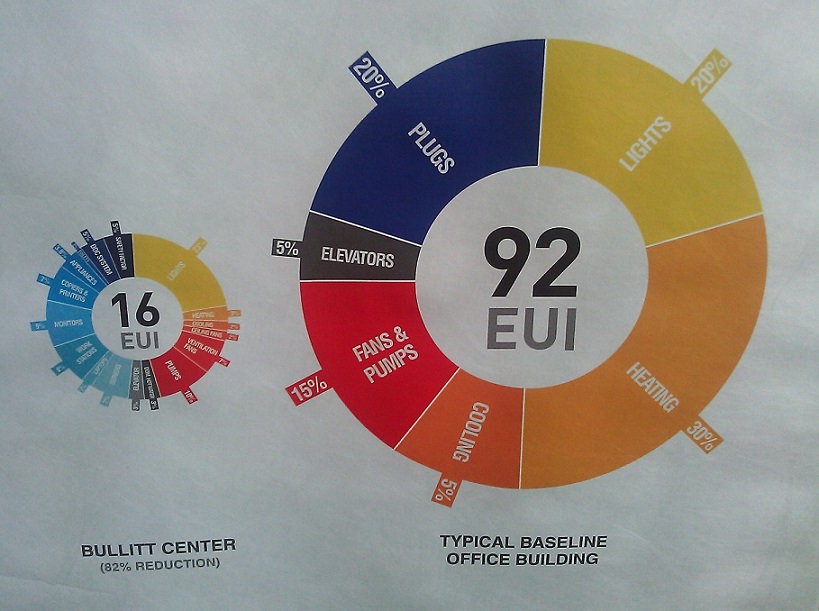
Typical commercial buildings of the same size have an Energy Use Intensity of 92, while the Bullitt Center is designed to have only 16 EUI. Photo credit: Louisa Gaylord
Most large commercial buildings have an Energy Use Intensity of 92, while the Bullitt Center is designed to have only 16 EUI. Photo credit: Louisa Gaylord

Continue reading “Getting to Net Zero with AIA: Change Your Mind”

Getting to Net Zero with AIA: Integrated Design

It’s impossible to deny that Seattle is at the forefront of sustainable building design in the US. Although there are more than 500 LEED-certified buildings in the city, LEED only lessens the damage of large construction projects. More developers are aiming for a Living Building Challenge, which creates net-zero buildings (and Seattle already has twice the number of certified projects than most other US cities). In order to reach these ambitious goals, integrated design is becoming increasingly important to the building process. Many investors see it as a serious commitment of both money and time, a commitment they are often unwilling to make. But Seattle’s variety of green buildings prove that integrated design produces structures that are economic, environmental, and enjoyable to work in.

Continue reading “Getting to Net Zero with AIA: Integrated Design”

Metropolis Editor Susan Szenasy Talks Seattle Design

Susan Szenasy has been the editor in chief of Metropolis magazine, a New York-based publication devoted to world design and architecture, for almost 30 years. She is an internationally recognized authority on sustainability and design, and sits on the board of organizations like the Council for Interior Design Accreditation and the Landscape Architecture Foundation. Susan recently came to Seattle to share a dialogue with an interested audience at an overflowing Seattle Design Festival event at Cornish College. I had an opportunity to sit down with Susan the morning after the event and hear a bit more about why she thinks the next big thing in art and architecture will come out of Seattle.

metropolis covers

Continue reading “Metropolis Editor Susan Szenasy Talks Seattle Design”

Hurtling into the Future, Faster Than a Speeding Bullitt

If anyone is qualified to be the president of the super-sustainable Bullitt Foundation, it’s Denis Hayes. On April 22, 1970, he organized the first Earth Day, an environmental protection event that is now celebrated in over 190 countries. Hayes was also the head of the Solar Energy Research Institution during the Carter administration, was named Time Magazine’s Hero of the Planet in 1999, and has received a national Jefferson Awards Medal for Outstanding Public Service. Hayes has been with the Bullitt Foundation since 1992.

Bullitt Center 3

Continue reading “Hurtling into the Future, Faster Than a Speeding Bullitt”

Bertschi School: Living Building to Live Up To

Kids love gross things. It’s one of those constants in life that you can depend on like clockwork, like taxes or shoppers behaving like inhuman monsters at Black Friday sales. But Bertschi School in Seattle (also my alma mater) uses this fact to their advantage in their new Living Science Building, which is changing how kids learn about the world they stand to inherit.

Bertschi School, on 10th Avenue East in Seattle, was founded by Brigitte Bertschi in 1975.
Bertschi School, on Capitol Hill in Seattle, was founded by Brigitte Bertschi in 1975.

Continue reading “Bertschi School: Living Building to Live Up To”